Skip to content

Code Monkey trackers · CMS custom firmware

CM107 + CM212

Vehicle tracking, local control and customer-owned privacy. Two installation options, one shared firmware platform, with output capabilities matched to the hardware.

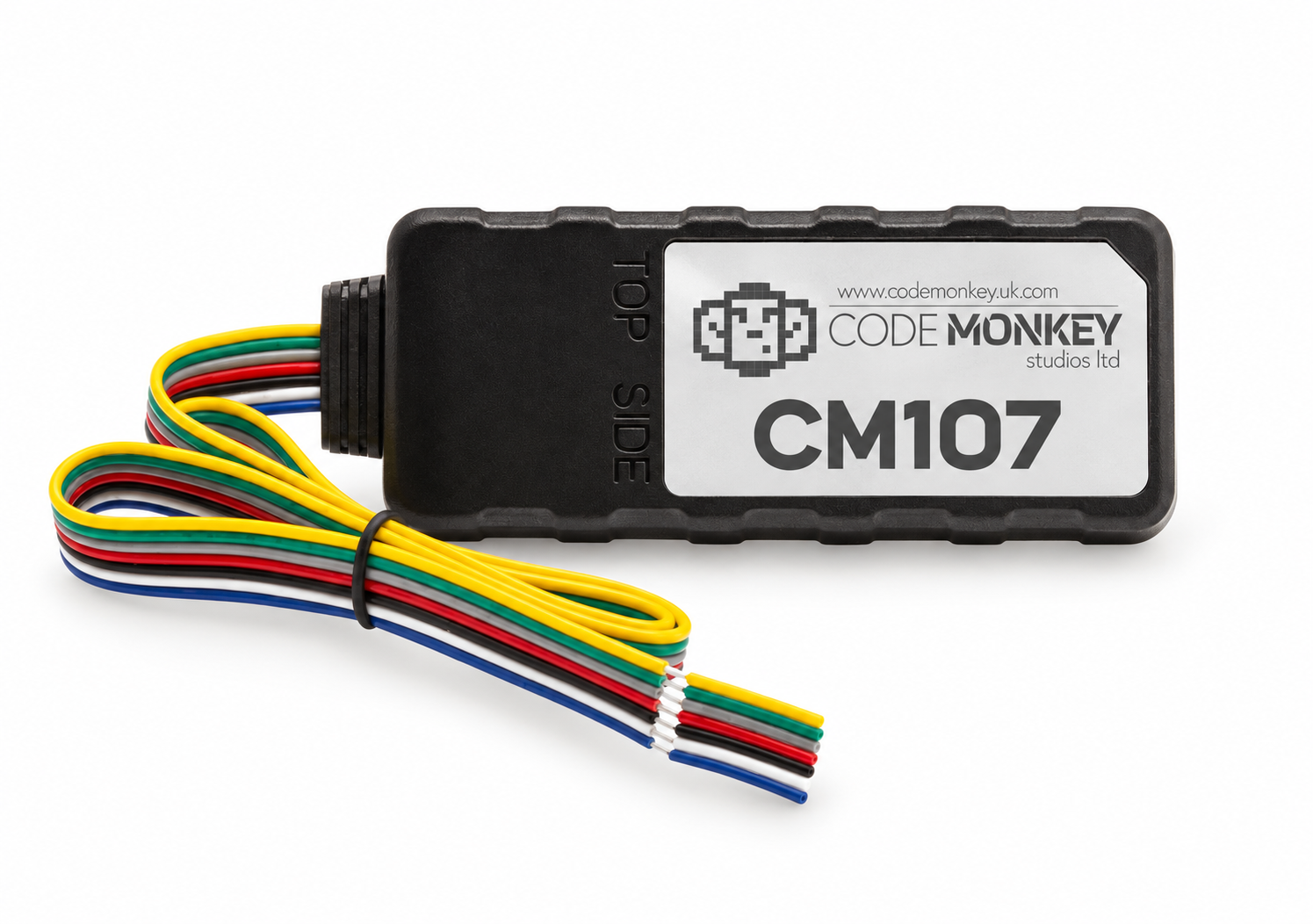
CM107 wired vehicle tracker branding mockup

CM107 · wired vehicle integration

Tracking with independent wired I/O

Based on TVC107 hardware running CMS firmware. A positive ignition input, a shared analogue/digital input and one internal output support wired integration. A compatible Bluetooth relay can be configured independently.

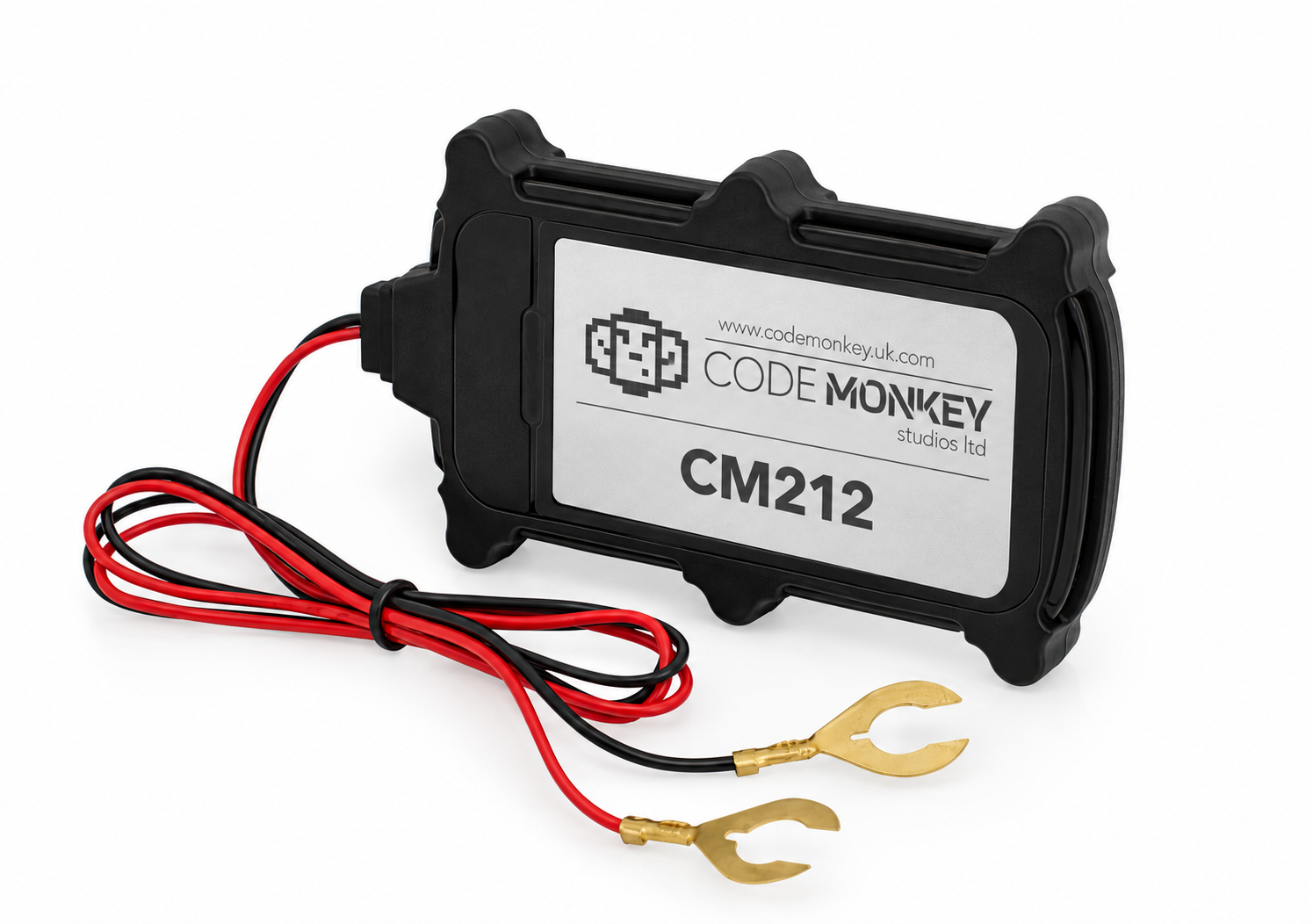
CM212 battery-mounted vehicle tracker branding mockup

CM212 · two-wire installation

Connect at the vehicle battery

Based on TBC212 hardware running CMS firmware. Two leads supply power from the vehicle battery, with a small backup battery. Ignition can use movement or voltage, and a compatible Bluetooth relay provides output switching.

Vehicle-powered: this is not a standalone long-life battery asset tracker.

Product images are branding mockups based on manufacturer images.

Choose the installation and I/O your vehicle needs
CapabilityCM107CM212
CMS tracking & recordingShared firmware platformShared firmware platform
Ignition sourceWired input, movement or voltageMovement or voltage
Analogue / digital inputOne shared terminal with selectable mappingNo external input terminal
Internal outputOne independent wired outputNone
Bluetooth relay outputCompatible configured relayCompatible configured relay
Phone output accessInternal output and/or compatible relayCompatible relay only
Supply / housing rating10–90 V DC / IP5410–90 V DC / IP67

Supply and housing ratings are manufacturer hardware specifications, not firmware certifications. Confirm the hardware revision, receiver and peripherals for the unit being supplied.

Track the journey. Understand the movement.

Normal reporting and dedicated Track recording keep their own settings and streams.

Flexible normal reporting

Separate moving and stopped acquisition with home, roaming and unknown-network profiles. Time, distance, course and speed changes can drive records, with configurable I/O, priority, thresholds and event-only reporting.

Detailed Track mode

Motion starts a dedicated stream of fresh GPS fixes and available calibrated X/Y/Z readings. Supported, identified CC1167Q receivers are requested to deliver a 250 ms navigation period: a target of four fixes per second.

Unknown receivers retain their native rate. Sustained 4 Hz operation remains to be qualified on hardware; missing fixes are never repeated to fill gaps.

Timed or continuous Track

Enable until cancelled or for up to 168 hours. Up to four chronological fixes share a Codec 8E packet, normally requested for upload each second. After 60 seconds without motion or fresh moving GPS, recording stops and remains armed.

Network conditions affect delivery. Timed activation needs valid UTC and resumes the remaining time after reboot.

Driver & trip events

Configurable harsh acceleration, braking, cornering, crash, idle and power-removal scenarios, trip state and odometer information. Automatic parked-position fencing and up to 50 configured circular or rectangular zones provide event rules.

Continuous calibration

Learn gravity and vehicle direction from suitable stationary readings and driving. The firmware keeps validating the mounting and can relearn after a change. Accelerometer driver classification waits for valid calibration.

Tilt tamper

A saved gravity reference detects a sustained mounting-angle change, with configurable angle, confirmation and speed suppression. A confirmed event invalidates calibration; an authorised remount needs an explicit reference reset.

Licensed tilt detection; it does not detect every displacement or rotation around a vertical axis.

Choose when to record and when to communicate

Specialist modes add control over connectivity and local recording.

Stun

Turn off tracking, logging, GPS, modem and Bluetooth until a chosen local date and time. A cancellation grace period precedes activation.

Log & Log Repeat

Capture locally with the modem off until a deadline, or repeat local recording followed by an upload attempt at a chosen 1–720 hour interval.

Periodic reporting

Set up to six local-time reporting slots per weekday. GPS, modem and Bluetooth are off between updates. Each slot attempts a fresh fix and a bounded upload; movement does not override the schedule.

Stun, Log, Log Repeat and Periodic each require a feature licence. Quiet modes deliberately suspend communication; storage capacity and upload windows remain finite.

Local Bluetooth and output control

Control the outputs the selected model actually has.

Phone output access

An authorised phone can list outputs, read reported states and request changes over Bluetooth without cellular coverage. Keys carry permissions and lifetimes; sessions authenticate requests and check sequence numbers.

Six timed actions per day

Up to six weekday slots switch a compatible relay or the CM107 internal output on or off, using local time and daylight-saving rules. Missed power-off slots are skipped; repeated daylight-saving times execute once.

Tags & advertising

Monitor configured supported tags and report presence changes, or transmit a licensed AirTag-style advertising identity. Receiving tags and advertising are separate features.

Compatibility must be checked. Advertising does not confer Apple certification or guarantee Find My discovery or location reports.

Relay control, phone access, tag monitoring and advertising are separately licensed. Bluetooth phone control of a relay needs both phone and relay permissions. An accepted command is not proof of a changed external circuit. Full phone/relay interoperability remains to be qualified.

Data ownership

Encrypted telemetry.
A customer-owned privacy option.

Level 2 protects telemetry and command/acknowledgement exchange while retaining identified devices and normal server processing. The receiving service must support CMS encrypted transport as well as Codec 8E.

Licensed Level 3 uses a customer-vault data key, pseudonym and a distinct per-device acknowledgement key. Chicane can store and acknowledge encrypted records while the customer client decrypts location data. Commands are encrypted by the client and relayed to the tracker.

Once provisioned, records are encrypted in the local journal, ordinary plaintext configuration is blocked and normal IMEI/ICCID DMS registration is suppressed. Physical factory reset clears settings, keys, records and the licence.

Pseudonym, sequence, size and traffic timing remain visible metadata. These firmware controls are not a claim of secure boot.

Ten licensed feature permissions

  • Stun, Log, Log Repeat and Periodic modes
  • Configured Bluetooth tag monitoring
  • AirTag-style advertising
  • Bluetooth relay control
  • Phone output-control access
  • Tilt tamper
  • Level 3 encryption

A signed offline licence is bound to the modem IMEI and processor identity. Current licences do not expire; a replacement board or modem needs a matching licence.

Normal tracking, Track mode, calibration, geofencing, storage, recovery, supported A-GPS and Level 2 have no separate feature bit. Timed Bluetooth actions inherit relay licensing. Permissions must be configured and enabled; no prices or bundles are specified here.

Storage, recovery and management

Designed for interrupted coverage, with clear limits and update status.

4 MiB offline journal

Complete records survive ordinary reconnects and restarts until acknowledged. Capacity is bounded: oldest records may be retired when full. Receivers should handle repeated unacknowledged data.

Configurable recovery

Escalate failed delivery through network reattachment, modem power cycling and an optional safe reboot, with cooldowns and power checks. Quiet recording policies retain priority.

GPS assistance & diagnostics

Inspect fixes, satellites, receiver time, speed and heading where supported. Force GPS requests acquisition and five-second reports during its serial lease. Supported receiver builds can use DMS-cached A-GPS assistance.

CMS Device Config

Model-specific controls, configuration read/write, licence import, encryption setup, a local named configuration library and import/export. Firmware controls verify model and package and separate upload from installation.

DMS fleet management

The CMS custom family supports model-targeted application jobs, configuration dispatch and update progress for ordinary registered devices, plus a separate central A-GPS service.

Explore DMS →

Chicane integration

Codec 8E records enter the tracking platform through compatible ingest. CMS Level 2 and the Level 3 blind-storage route add the corresponding encrypted transport and customer-vault workflows.

Explore Chicane →

Firmware implementation and validation

Feature scope reviewed on 12 October 2026 against the CMS 25.02.x firmware and the supplied feature guide. CM107-equivalent hardware booted 25.02.43 by serial. The 25.02.44 DMS test lost its network after the package header, so complete remote installation is not validated. CM212 25.02.42 was built but not live boot-tested in that cycle.

Sustained four-fix-per-second Track recording and full phone/relay interoperability remain under qualification. CC1167Q A-GPS download and injection were tested on the CM107-equivalent unit; other receiver variants need confirmation. Choose a validated firmware and compatible hardware combination for each deployment.

Read the complete feature and licensing guide →

Build the tracker package your service needs.

Talk to Code Monkey